Author of GodotAwesome. She is creating valuable, reader-friendly content for the GodotAwesome community!.
Use Claude, ChatGPT & Grok with Godot (MCP Guide for Cursor & More)
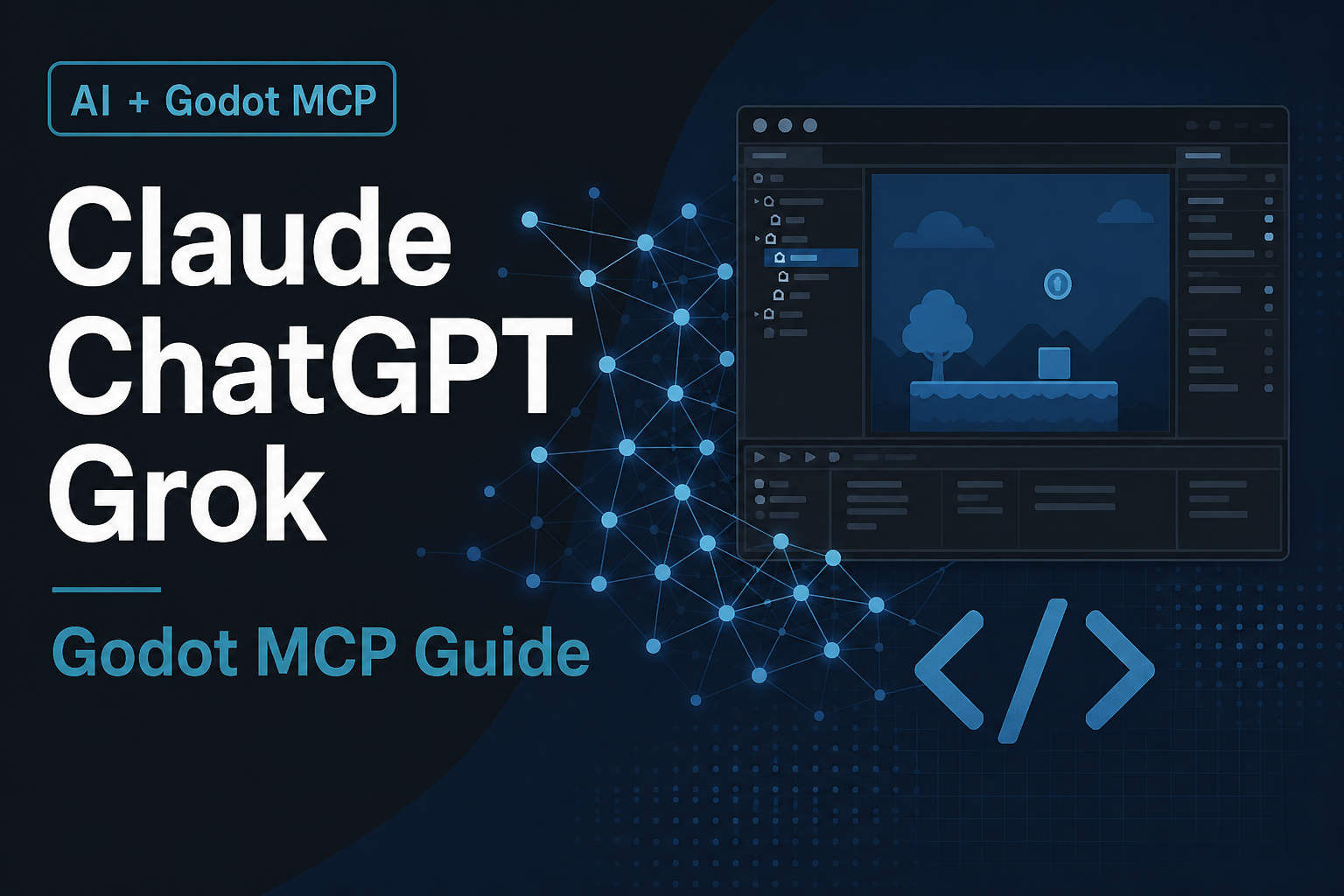
Want to use AI with Godot? Claude, ChatGPT, Grok, and Cursor do not control the editor by themselves. You connect them with MCP (Model Context Protocol).
This guide is the short path: what MCP is, how to wire it up, and what usually breaks.
For a broader overview of Godot MCP ideas, see Godot MCP Server: AI integration.
30-second answer
- Install a Godot MCP server or plugin
- Keep Godot open on your project (many setups need the editor running)
- Add that MCP server in your AI client (Claude, ChatGPT/Codex-style clients, Grok-capable MCP clients, or Cursor)
- Ask the AI to list tools / inspect the open scene
- If tools fail, fix port, path, or "Godot not connected" first
AI client (Claude / ChatGPT / Grok / Cursor)
    → MCP server
        → Godot editor / project
What MCP actually does
Without MCP, AI mostly edits files on disk. Useful, but blind to the live editor.
With MCP, the assistant can often:
- Inspect project / scene structure
- Create or tweak nodes (depending on the server)
- Run or stop the project
- Read debug output / errors
- Help you iterate without copy-pasting the whole tree by hand
Capabilities differ by MCP implementation. Treat the README of the server you install as source of truth.
Pick a Godot MCP option
There is more than one "godot-mcp" out there. Rough map:
| Type | Good for | Watch out |
|---|---|---|
| Godot plugin (GDScript / SSE) | Fast install inside a project, Cursor/Claude-friendly | Godot must be open; local port only |
| Node.js MCP server | Cursor / Claude Desktop style command config |
Needs Node, build step, absolute paths |
| Plugin + Node bridge | Editor WebSocket + external MCP client | Two parts to keep in sync |
Practical rule: start with one maintained option, get a green connection, then explore features.
Useful starting points:
- Godot Asset Library (search Godot MCP)
- Community GitHub repos named
godot-mcp(check recent commits + Godot 4 support)
Setup A: Cursor (most common for game repos)
Cursor speaks MCP natively. Godot still needs a server.
1. Install / enable Godot MCP
Example path for a plugin-style install:
- Copy the addon into
res://addons/... - Project → Project Settings → Plugins → enable it
- Start the MCP / bridge from the plugin UI if it has a Start button
- Note the local URL or port (often something like
127.0.0.1:3000)
For Node servers, clone, npm install, npm run build, then point Cursor at dist/index.js or build/index.js.
2. Add the server in Cursor
UI path: Cursor Settings → MCP → Add server
Or project file .cursor/mcp.json:
{
  "mcpServers": {
    "godot": {
      "command": "node",
      "args": ["C:/absolute/path/to/godot-mcp/build/index.js"],
      "env": {
        "DEBUG": "true"
      }
    }
  }
}
SSE-style plugins may ask for a URL instead of a command, for example:
Type: SSE
URL: http://127.0.0.1:3000/mcp
Use the exact URL from your plugin docs. Do not guess the path.
3. Verify
- Reload MCP in Cursor
- Open Agent chat (tool calls need agent/tool mode)
- Ask: "What Godot MCP tools do you have?" or "Summarize the current scene tree"
- If the answer matches your open project, you are connected
Setup B: Claude (Desktop / Code / MCP-capable clients)
Claude connects the same way other MCP clients do: config entry → local Godot MCP server.
Typical flow:
- Godot MCP running
- Add server in Claude's MCP settings (or the client's config file)
- Restart / reload tools
- Test with a read-only request first (list scenes, get project info)
If your Claude client supports one-click config from a Godot plugin panel, use that, then confirm the tool list populated.
Setup C: ChatGPT and other OpenAI-style MCP clients
If your ChatGPT / Codex / OpenAI tooling supports MCP servers:
- Run the same Godot MCP process locally
- Register it as a custom MCP server in that client
- Prefer read tools before write tools until you trust permissions
Exact menus change by product. The Godot side stays the same: local bridge + project open.
Setup D: Grok and other MCP clients
Same pattern again:
- Local Godot MCP server
- Client MCP config pointing at command or SSE URL
- Confirm tools appear
- Ask for a scene summary before editing anything
If a client does not support MCP yet, you can still use AI on GDScript files in the repo, but that is not a live Godot connection.
What to ask first (safe prompts)
Start small:
- "List available Godot MCP tools."
- "What is the current root node of the open scene?"
- "Summarize
project.godotrendering and physics settings." - "Create a temporary Node2D named
McpTestunder the root, then delete it."
Save bigger refactors for after you see correct readbacks.
What AI is good at here
- Boilerplate scenes and scripts
- Explaining error spam from the debug console
- Repeating boring node setup
- Cross-checking your project structure while you design
What AI is bad at (still)
- Shipping feel / game design taste
- Blindly rewriting your whole architecture
- Fixing physics tuning without playtesting
- Anything that needs the wrong MCP server version for your Godot version
Keep Git commits handy. Treat MCP writes like any other automation.
Common fixes
| Problem | Likely fix |
|---|---|
| Tools missing in Cursor | Reload MCP; use Agent chat; restart Cursor |
GODOT_NOT_CONNECTED |
Open Godot, enable plugin, start server, match port |
Cannot find module ... index.js |
Wrong absolute path; run build; fix mcp.json |
| SSE URL fails | Confirm server is Running; try 127.0.0.1 not localhost quirks; check firewall |
| AI edits files but not scenes | You are in normal coding mode without MCP tools approved |
| Weird half-broken scenes | Disable write tools, reset scene from Git, retry with smaller prompts |
Never expose the MCP port to the public internet. Keep it on 127.0.0.1.
Minimal checklist
- Godot 4 project opens cleanly
- MCP addon/server installed and running
- AI client shows the Godot server as connected
- Read-only tool call works
- Tiny write + delete test works
- Then use it for real tasks
FAQ
Does Cursor connect to Godot natively?
No. Cursor connects through MCP. Without a Godot MCP server, Cursor is just a strong code editor for your scripts.
Can Claude / ChatGPT / Grok control Godot?
Yes, if the client supports MCP and you point it at a running Godot MCP server. The models differ; the bridge pattern is the same.
Is this the same as ChatGPT writing GDScript?
No. File chat helps with code. MCP can reach the editor/runtime bridge (scene tree, run/debug, etc.), depending on the server.
Do I need a paid Cursor plan?
Tool-calling / agent features can depend on your client plan. Check current Cursor MCP/agent requirements if tools never appear.
Which Godot version?
Prefer Godot 4.x builds listed by your MCP server. Godot 3 projects are a different world.
Bottom line
To use Claude, ChatGPT, Grok, or Cursor with Godot in a real editor-aware way:
- Run a Godot MCP bridge
- Register it in the AI client
- Verify with a read tool
- Only then let it edit scenes
That is the whole AI + Godot MCP setup story.
Resources: